Strategic Planning for Refinery Turnarounds
- Read more about Strategic Planning for Refinery Turnarounds
- Log in or register to post comments
Hazard Area Flow Meter Measurement Solutions
Macnaught hazard-rated flow meter products offer global approval ratings, high accuracy, and repeatability with no flow conditioning required. Designed for clean process fluids that require explosion-proof, Intrinsically Safe, or Simple Safe measurement needs. Macnaught is the leading Oval Gear Flow Meter manufacturer worldwide - and has been since 1964.
Macnaught Hazard Area Flow Meter Portfolio
Flame Proof (ExD) Flow Meter
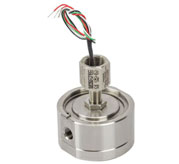 Macnaught's ExD C1D1 flow meter is built off the legendary MX flow meter assembled to a ExD Flameproof Class 1 Division 1 sensor approved with all major certifications FM-US, FM-CA, ATEX and IECEx.
- Flow Ranges from 0.13 GPH to 600+ GPM in sizes 1/4" thru 4"
- Pulse output is NPN type
- Temperature ranges from -56°F to 284°F
- 0.5% volumetric accuracy with 0.03% repeatability
- ExD Meters, displays and flow computers in stock
- 3 meter cable
- Large stock of ExD displays on hand
Intrinsically Safe (Ex ia) Flow Meter
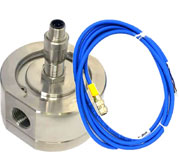 Macnaught's Ex ia Intrinsically Safe flow meter meets all major C1D1 approvals and certifications and supersede C1D2 requirements with FM-US, FM-CA, ATEX and IECEx.
- Flow ranges from 0.13 GPH to 600+ GPM in sizes 1/4" thru 4"
- Stocked output is a proximity sensor with Namur connection and 15-meter cable
- Temperature range -13°F to 158°F
- Optional omni polar NPN sensor available
- Safety barrier provided by others. Entity parameters to size barrier:
- Ui = 20v li= 60mA Pi = 200mW Ci = 150nF Li = 150uH
- I.S Displays in stock
Simple Safe (Ex ia) Flow Meter
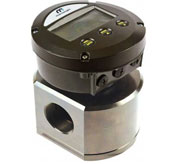 Macnaught's latest hazard offering allows for non-powered hazard meter application. Perfect for remote locations or areas where power is not available. The MX Meter is mated with Macnaught's Simple Apparatus PCB and meets all global intrinsically safe areas.
- PCB is completely passive and adds no energy to connected circuits.
- Rate and total only option are completely non-powered.
- Batch and output versions require power, and a safety barrier (provided by others) see instructions for entity parameters.
- Temperature ranges: -40°F to 158°F
- Rate and total are standard display, batch and relay options available.
Learn more: MX Hazard Zone Flow Meters
Mechanical Register Flow Meters
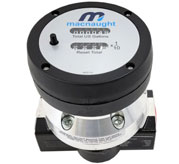 Macnaught's long standing Mechanical Register Industrial Flow Meter range allows for non-powered hazard measurement applications. Easy for operators to reset and record values.
- 1% volumetric accuracy
- Heavy duty industrial grade build
- Flow direction dependent
- Well suited for no power hazard fluid measurement options
Talk to one of our experts today at (855) 737-4715, or fill out our online form to learn more.
Migrating from Parker AC890 Drives: Guide to AC20 and AC30 Upgrades
Levi Transtrum || Valin Corporation
Parker AC890 series variable frequency drives (VFDs), long used for industrial automation and motion control applications, are now being phased out. To ensure uninterrupted operations, it's critical for businesses to understand their migration options. Valin is committed to guiding our customers through this transition with clarity and expertise.
Why Migrate?
Parker Hannifin's Electronic Motion and Controls Division has officially announced the obsolescence of the AC890 drives. As of May 2025, Parker encourages customers to migrate to the newer AC20 or AC30 series drives, depending on specific application needs and complexity.
Choosing the Right Replacement: AC20 or AC30?
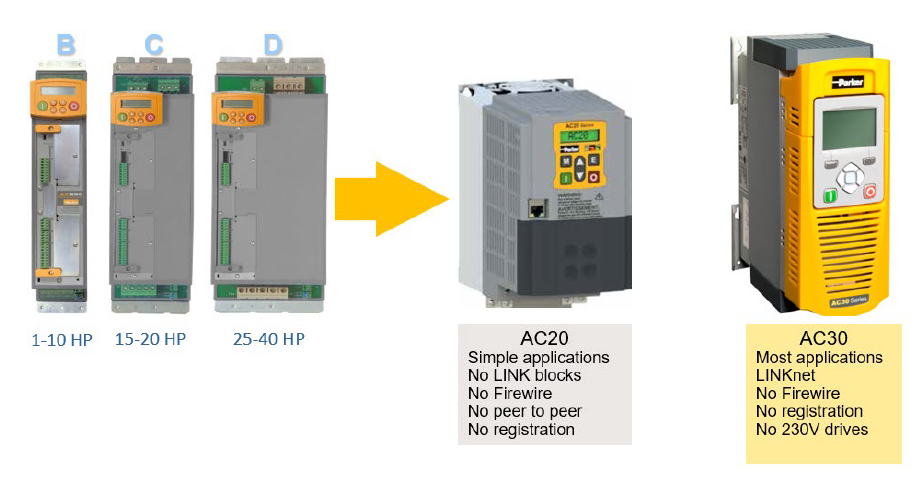
AC20 Drives: Ideal for simple applications.
- Suitable when advanced features like Firewire, peer-to-peer communication, or registration are not required.
- Available for systems up to 250HP.
AC30 Drives: Required for more sophisticated control and networking, or higher power outputs.
- Suitable for most AC890 applications
- Uses LINKnet networking in place of Firewire
- Available exclusively in 460VAC
Navigating Migration Complexities:
Common challenges during migration and practical solutions include:
| Challenge | Recommended Solution |
| Firewire Dependency | Transition to LINKnet, which is supported natively by AC30 and through add-on cards in AC890. |
| Registration Applications | Currently not supported on AC30; alternative approaches may include other Parker products or re-engineering the system. |
| Common-Bussed Systems with 890CS or 890CD Drives | There is no single direct replacement available for these drives. However, Valin can provide engineered solutions for replacement of these systems. |
For detailed technical explanations, see the Parker Migration Paths document.
Valin’s Support: Expert Migration Assistance
Valin doesn't just supply hardware—we provide complete engineering solutions, including:
- System Audits & Recommendations: Identifying the best migration path based on your current setup and application needs.
- Engineered Solutions: Customized retrofit plans for complex setups such as common-bussed systems.
- Product Support: Our experts can help with technical questions that may arise anytime before, during, and after installation.
Act Now to Avoid Downtime
Timely migration prevents costly downtime and ensures your systems remain robust and future-proof. Valin’s specialists are ready to assist you through every step of this transition.
Contact our expert team today to discuss your migration plan at?(855) 737-4716 or fill out our?online form.
Have You Ever Been Frustrated by Complex VFD Configurations?
Levi Transtrum || Valin Corporation
Complex drive configurations can turn straightforward motor control installations into costly, time-consuming challenges. If you've ever struggled with getting a VFD up and running due to confusing parameter setups, or faced extended downtimes when replacing a VFD due to the complexity of replacing an old unit, Parker’s AC Series Drives offer a clear, streamlined solution for a variety of industrial applications. 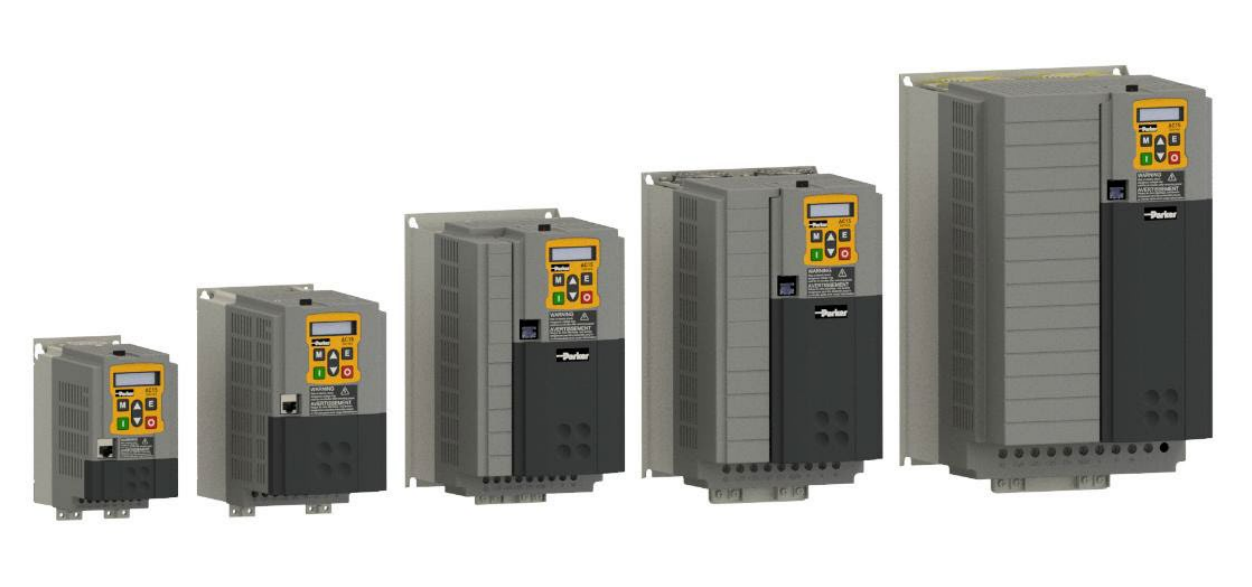
Quick, Easy Setup with Parker AC Series Drives
Parker's AC Series is designed for simplicity and ease-of-use in a low-cost, compact package. Whether your needs involve compact drives for OEM machines, advanced general-purpose drives for demanding tasks, or modular drives for flexible installations, Parker AC Drives simplify the entire setup process.
- Intuitive Configuration and User-Friendly Software: Eliminate confusion with Parker’s intuitive software interfaces. From initial setup to advanced operational tweaks, Parker’s straightforward Drive System Explorer (DSE) software offers a more intuitive function block-style programming interface with preloaded libraries for most common applications. This simplifies the commissioning process by significantly cutting down installation time and complexity. For more advanced programming, Parker Developer offers a universal Codesys-based IEC61131-3 programming environment.
- Flexible Integration into Existing Communications: With built-in support for Modbus TCP/IP and options for popular industrial fieldbus protocols including Modbus RTU, Profinet, Profibus, Ethernet/IP, EtherCAT, and CANopen, Parker AC Series Drives can integrate seamlessly with your existing control architecture. Expandability and modularity ensure that the drives easily adapt as your system requirements grow.
- Application Cloning: Parameter setups can be cloned between Parker AC Drives with a simple microSD card, making in-the-field replacements or firmware upgrades trivial to perform.
Why Customers Prefer Parker AC Series Drives:
- Simplified Installation: Avoid complex configurations with intuitive setup wizards and clear, user-friendly interfaces.
- Faster Commissioning: Accelerate operational readiness with straightforward, step-by-step installation procedures.
- Dependable Performance: Ensure consistent, reliable operation through durable construction and advanced design features.
- Compact and Cost-Effective: Save money and space with a compact design at a low price point.
Stop wasting valuable time on complicated drive configurations. Choose Parker’s AC Series Drives and streamline your installation processes for greater productivity and reliability, and efficiency.
Learn more about the complete Parker AC Series Drives.
Contact us at?(855) 737-4716?to schedule an engineering consultation or request a proof-of-concept demo, or fill out our?online form?to learn more.
Hydrogen and Clean Energy
Cory Calderon || Valin Corporation
The Inflation Reduction Act of 2022, signed on August 16, aims to accelerate clean energy innovation, including hydrogen and fuel cell technologies. With increased focus on hydrogen, it's crucial to clarify misconceptions and understand how hydrogen fits into the clean energy landscape.
Hydrogen doesn’t occur naturally in usable form and must be produced. The environmental impact of hydrogen depends heavily on its production method—classified as grey, blue, or green hydrogen.

Grey hydrogen, which makes up over 90% of U.S. hydrogen production, is created through steam-methane reforming (SMR), a process that emits significant carbon dioxide. This method persists because it leverages existing natural gas infrastructure, making it the most economical option today.
Blue hydrogen also uses the SMR method but includes carbon capture and storage (CCS), preventing emissions from entering the atmosphere. While environmentally preferable to grey hydrogen, it’s often misrepresented as "green." In truth, it is a cleaner—but not emission-free—option.
Green hydrogen is the cleanest form, produced via electrolysis powered by renewable energy sources like wind or solar. It emits no carbon, but it requires large volumes of purified water and significant infrastructure investment. This makes it the most expensive and technically demanding option.
The current challenge lies in transitioning from the entrenched fossil fuel-based system to cleaner hydrogen solutions. Grey hydrogen remains cheaper than blue, which in turn is cheaper than green. These cost differences influence adoption rates and how incentives under the Inflation Reduction Act are applied.
When companies scale back hydrogen projects, it doesn’t mean hydrogen is failing. Often, it's a response to cost-benefit realities—where green hydrogen isn’t yet viable for light-duty transport but may make sense in industrial or chemical sectors where demand is high and infrastructure is more adaptable.
The future of hydrogen depends on proper incentives, supportive policy, and reducing the cost gap between grey and green hydrogen. With new tax credits and increased federal backing for both blue and green hydrogen projects, the shift toward cleaner hydrogen is underway. While hydrogen isn’t yet a universal solution, particularly at the consumer level,
It remains a vital component of the broader strategy to decarbonize hard-to-electrify sectors. I wrote a full article on this topic for Power Magazine last year. If you’d like to learn more, I suggest you give it a read.
Call us today at (855) 737-4714 to learn more or fill out our online form and someone will get back to you.