Applied Materials
Author info
Buyer, Applied Materials
Full description
Working with Valin has been an exceptional experience. The team is incredibly responsive and makes my job much easier. We collaborate closely, holding regular meetings to ensure smooth operations and overcome supplier challenges together. Their dedication and problem-solving efforts have played a crucial role in our success. Valin’s passion for delivering the best experience is evident in everything they do. Their authenticity, enthusiasm, and commitment to meeting our needs help generate more revenue and build customer trust. They consistently step up to take responsibility and ensure on-time delivery of complex and highly precise parts. I truly appreciate the partnership and look forward to continued success together!
Author
Abdul Shahid
ACS's Advanced Dynamic Focus Control Solution
Corey Foster || Valin Corporation
Have You Wished You Could Focus On Your Samples Better?
Have you ever wished for sharper, clearer focus on your samples, regardless of surface variations or dynamic conditions? AutoFocus technology offers a transformative solution, ensuring optimal focus precision for imaging and process equipment, even in challenging environments.
What Makes ACS’ Advanced Dynamic Focus Control Technology Stand Out?
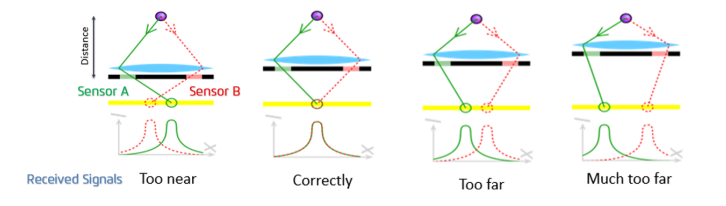
At the heart of the AutoFocus solution lies a cutting-edge algorithm that dynamically maintains the ideal focus. Whether you're working with a camera, laser source, or microscope, this system bridges the gap between position control and focus quality.
- Adaptive Precision Across Uneven Surfaces
Flat surfaces are simple to focus on, but real-world applications often involve irregular terrains. AutoFocus uses a sensor-based feedback system that continually adjusts to maintain the correct distance between your equipment and the surface, ensuring consistent performance. - Innovative Sensor Integration
The system employs sophisticated sensors to measure light intensity and calculate precise focal distances. These sensors communicate real-time feedback to the controller, allowing for instantaneous adjustments and delivering unmatched clarity. - Seamless Control Loop Switching
Unlike conventional methods relying solely on encoder feedback, this technology switches between position and focus control loops. It reacts to dynamic changes by leveraging sensor-driven data, ensuring both accuracy and adaptability.
The Technology Behind the Solution
Focus Feedback Control
The AutoFocus algorithm compares the current focus position with the desired point and minimizes errors through real-time adjustments. This ensures consistent performance, even in changing environments or with unpredictable surfaces.
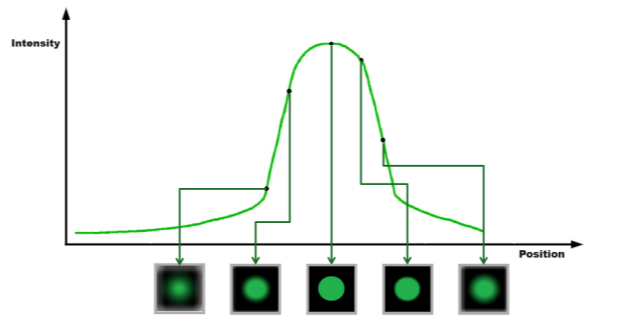
The light intensity indicates distance to the focal point. The distance of the lens to the ideal focal point can be calculated from the light intensity and the distance between the sensors.
Control and Quality Signals
The system processes two critical inputs:
- Control Signal: Governs focus adjustments to minimize error.
- Quality Signal: Ensures that the incoming data is robust enough for optimal functionality.
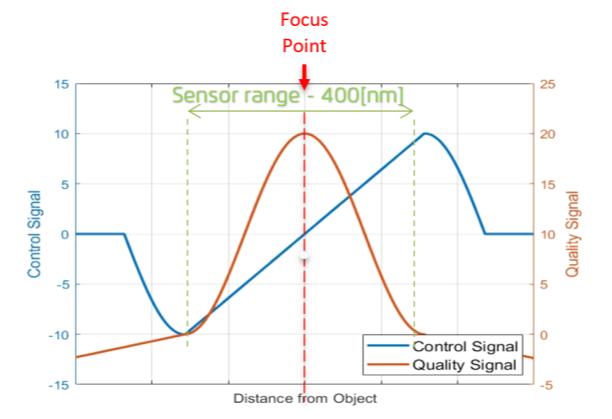
Together, these signals create a feedback system that guarantees both precision and reliability.
Versatile Signal Sources
The AutoFocus system is compatible with multiple input sources:
- Analog signals from general-purpose inputs.
- Sine/Cosine encoders for enhanced accuracy.
- SPI communication protocols, providing data-rich feedback loops.
This versatility ensures seamless integration into diverse applications.
Supported Products and Applications
AutoFocus is available across a range of ACS’ product lines, including UDM, IDM, and ECM series drives, each designed to support a single AutoFocus axis. These drives offer exceptional compatibility with various signal types, enabling tailored solutions for unique operational needs.
For compact or single-axis applications, the MDMst drive provides a focused solution with some limitations, making it an ideal choice for smaller setups.
Why Choose Our AutoFocus Technology?
With features like real-time adaptation, sensor-driven precision, and compatibility across multiple signal types, this AutoFocus technology redefines what's possible in imaging and process control. Whether you're enhancing microscopic imaging, perfecting laser alignment, or automating dynamic systems, this innovation empowers your workflows with unparalleled efficiency and accuracy.
Don’t let surface variations or manual adjustments slow you down. Embrace the future of precision with ACS’ AutoFocus technology today!
For more information on ACS’s AutoFocus control technology please call (855) 737-4716 or fill out our online form and one of them will contact you.
Acromag’s Ethernet Remote I/O Modules Add Profinet Communication
Acromag
Expandable Ethernet I/O modules now support three field-selectable protocols for networks using Profinet, EtherNet/IP, and Modbus TCP/IP.
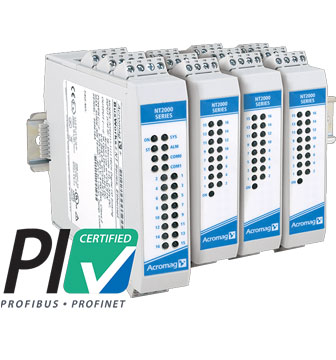 Acromag’s new BusWorks? NT series remote I/O modules are now enhanced with Profinet support. Profinet is traditional Ethernet combined with an industrial application layer protocol targeted to industrial automation. Applications for these high-performance Ethernet I/O modules are remote monitoring and control, factory automation, process instrumentation, predictive maintenance, HVAC/energy management, motion control, and more.
These modules were tested at the PROFI Interface Center and received a certificate of conformance to the Profinet standards from the PROFIBUS Nutzerorganisation. The certification ensures interoperability across vendors and systems.
NTE Ethernet I/O models have dual RJ45 ports and a webserver for monitoring or controlling its I/O channels interfacing sensors or actuators with system controllers. The communication protocol is field-configurable for Profinet, Modbus TCP/IP or Ethernet/IP communication. Each I/O module offers up to 16 input or output signals for voltage, current, temperature, TTL, and relay control signals. An integrated DIN rail bus enables connection of up to three NTX expansion I/O modules, supporting 64 channels with a mix of I/O functions networked on a single IP address. NTE Ethernet I/O modules distribute 9-32V DC power along the DIN rail bus to NTX expansion modules. The space-saving design requires only 25mm of DIN rail per module. Hazardous location approvals, high noise immunity, and -40 to 70°C operation make this I/O ideal for use in harsh environments.
“NT Series Ethernet I/O modules are user-configurable for Profinet, Ethernet/IP or Modbus/TCP, offering a convenient solution for monitoring remote equipment across multi-protocol control systems,” states Robert Greenfield, Acromag’s Business Development Manager.
The NT2000 Series offers a broad variety of I/O signal processing options. Fifteen I/O configurations are available as either NTE Ethernet I/O or NTX expansion I/O models. Analog I/O models feature eight differential or sixteen single-ended inputs for monitoring current or voltage signals. Analog output modules drive eight channels of process current or voltage signals to control various field devices. Discrete I/O models provide 16 tandem input/output channels with either active high/low input and sinking/sourcing output. A six-channel mechanical relay output model is also available. For temperature monitoring, thermocouple and RTD input models support many sensor types, as well as resistance and millivolt ranges. More models will release over the coming months for additional I/O functions.
Each module will support all three industrial Ethernet protocols which are selectable using any web browser to configure the network settings and I/O operation. The modules typically function as a network server but also offer Acromag’s i2o? peer-to-peer communication technology to transfer data between modules directly or multicast without a host or master in between. Conditional logic capabilities let users control operations with IF/THEN/ELSE statements.
Talk to one of our experts today at (855) 737-4716, or fill out our online form to learn more.
Parker Control Tech Tour is Hitting the Road
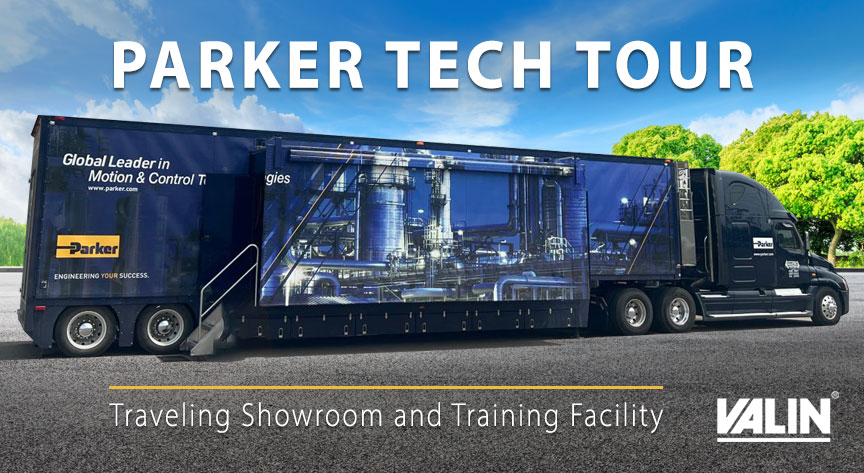
Valin and Parker are teaming up to host an exclusive event, showcasing process control products. Explore Parker's state-of-the art 68’ expandable tractor-trailer with a customized display room featuring flow, control, pressure and corrosion control products and solutions.
What visitors can expect
- All-in-one Company, Product & Solution introduction in the span of 2-3 hours
- Virtual and hands-on demo featuring best in class and new products
- Physical, hands-on demos accompanied with a subject matter expert
- Application workshops (by request) targeted to engineers, planners or technicians
- A casual, low-pressure, no-expectation event meant to educate and inspire application discussions
What do you need from me?
- Just your registration, a dedicated Parker Tech Tour representative will reach out to learn more about your needs and go over the event details and logistics with you.
Parker Tech Tour Dates for 2026
We’re excited to announce the upcoming Parker Tech Tour dates for 2026. This year’s tour will span April 6th to April 24th, with stops across the western U.S. — bringing product demos and expert insights closer to you:
Week 1 — April 6–10: Southwest Arizona
Week 2 — April 13–17: Southern California
Week 3 — April 20–24: Northern California / Pacific Northwest
* Scheduling may be flexible to accommodate a region or customer, please contact us for more information to explore options.
Plan your visit and register today to secure your spot at a location near you!
If you are interested in attending, just fill out the form below.
Have questions? Call (855) 737-4714 or fill out our online form and someone will contact you.
The Art of the Crossover
Corey Foster || Valin Corporation
Automated machines have been operating for decades now, which makes maintenance a critical piece of the puzzle. These automated machines break down or need service attention just like any other, and inevitably, maintenance technicians will need to search out replacement parts to keep the equipment up and running. This is not as simple a concept as it may seem on the surface. Often, they run into challenges. Perhaps the part they are looking for is discontinued. Or maybe it’s unavailable at the time. Or maybe there is a shipping issue, and they can’t receive it for an extended period of time. As we all know, there is always a possibility that a shipping crisis rears its ugly head. In these situations, decision makers will look for alternative components from a different manufacturer. This may sound good in theory, but there are nuances to this exercise that must be examined. In our world, we call this “doing a crossover.”

Successful crossovers are most common when there is clear and open communication between the supplier and the customer. After all, there are usually several interested parties on the customer side, and they all have their own priorities. There are machine builders and machine users and they each have their own requirements and goals.
Machine builders start with a desired goal for the machine. These are activities like loading pills in a bottle or maintaining a level in a tank. When the machines are designed, products are selected to meet the goal of that machine.
However, the machine user typically has other challenges they are trying to overcome. They have the added pressure of getting a broken machine up and running. They may not have the inside knowledge that the machine designer does, they may just know the part number.
Finally, there is the supplier to consider. This person may receive a call for a quote to a certain part number “or its equivalent.” Without context, trouble could ensue. Who is making the request? Does the requestor have the authority to substitute parts? Many times, the requestor doesn’t have all the information needed to make such a substitution successfully.
It's a complex process, and what’s most important is that for a crossover to be successful, more information is better than less. That way all interested parties are informed and we can be sure, and everyone’s needs are being met.
We did a more in-depth discussion on this topic in Control Design Magazine last year. I encourage you to take a look, and feel free to reach out with any questions you may have.
Need help selecting the right replacement parts? Speak to one of our technical specialists today at (855) 737-4716 or fill out our online form and one of them will contact you.