Turnarounds: Keeping Inventory Under Control

Kari Kohonen || Valin Corporation

When we talk about planning for a shutdown at a refinery, one of the most critical elements on the checklist is inventory management.  To get the very most out of the time you have during the shutdown itself, you need to properly identify the parts needed well in advance.  In fact, for some fittings and valves, we recommend as much as an 18-month head start.

 

Turnarounds: Keeping Inventory Under Control
 

First, we need to understand what equipment is being worked on during the shutdown. From there, simple correlation can go a long way.  For example, the number of valves scheduled to be repaired during the shutdown will dictate how many fittings will be needed.  Additionally, the type of unit comes into play.  A crude unit will have more piping and components.  This is simply an example but just know that there are specific requirements that must be met depending on the type of equipment as well as the volume.

During this time, it’s nice to have a vendor that views your business as a partnership as opposed to just a transactional relationship.  A supportive vendor will want to discuss how the plant intends to support its maintenance personnel with the product in question.  This will affect recommendations in terms of where the plant is going to physically store the parts.  

Finally, by engaging a good inventory management specialist during the planning period, you can achieve that peace of mind from a safety perspective.  Some equipment doesn’t play well with others, and you need to know that.  A good vendor can help you mitigate this risk.

Valves are their own animal.  The cycle can be similar to fittings, but it is far more complex. Current performance needs to be compared to the expected performance and the proper tuning should be scheduled.  Alternatively, perhaps simple tuning isn’t the answer.  Were the valves sized incorrectly to begin with?  Then we get into the notion of cavitation and noise abatement.  If cavitation is present, the valve will eventually fail.  Determining what the cause is of that cavitation is the only way to put together an effective game plan to solve it. Undersized actuators are another leading culprit for valve issues as they can lead to their premature failure.

The main takeaway is that there are many elements that need to be addressed during a shutdown for it to be deemed successful.  The only way to effectively address these elements is through strong communication and meticulous planning.  The team here at Valin has been assisting plants in planning their turnarounds for years, and we hope that if you have one on the books, you’ll reach out and see how we can help.  If you’d like to read more detail about some of the concepts I’ve presented here, be sure to read the full article I had published in Hydrocarbon Processing Magazine last year.

Learn more about Valin's Inventory Management Services.

Contact our Refining Knowledge Center at (855) 797-6388, or email us at refining@valin.com to learn more.
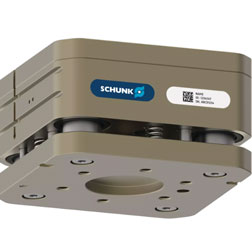
Have you struggled with misaligned parts or costly tolerance errors in robotic material handling?

Corey Foster || Valin Corporation

AGM Compensation Units from SchunkIf so, Schunk’s AGM Compensation Units may be the solution you’ve been looking for.
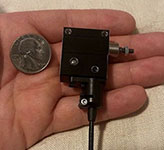
In automated environments, tasks like machine loading, insertion, and bin picking often face the same challenge: even the smallest misalignment can damage workpieces, wear out grippers, and slow down cycle times. Traditional robots are not designed to naturally compensate for these inaccuracies, which means tolerance issues can lead to error messages, scrap, or manual rework.

The AGM Series Compensation Units from Schunk eliminate these pain points by introducing flexibility between the robot and the workpiece. With compensation available in up to five degrees of freedom (X, Y, Z, W, and rotational axes), AGM units absorb tolerances, stabilize processes, and protect valuable tooling.


Key Value Propositions

Boost Machine Loading Efficiency

  • AGM-XYZ units stabilize the workpiece during loading/unloading, absorbing forces in multiple directions. This results in smoother part placement, less wear on grippers, and optimized machine utilization.

Achieve Reliable Insertions

  • Whether you’re assembling circuit boards or engine blocks, AGM-XY units compensate for positional inaccuracies, preventing downtime and scrap while enabling high-volume, precise insertions.

Solve Bin Picking Challenges

  • Undefined part positions and orientations can stall bin picking. AGM-W units provide angular compensation and pneumatic locking, enabling robots to grip components securely, speed up cycle times, and even handle delicate or fragile items.

Adapt to Your Application

  • With nine series and load ranges from a few grams to over 400 kg, the AGM portfolio covers everything from small precision tasks to heavy-duty industrial jobs.

Customizable for Unique Needs

  • From E-Mobility applications requiring sensitive battery handling to specialized integration setups, Schunk offers custom-engineered AGM units that match your process requirements.


Why Choose AGM Compensation Units?

At the end of the day, compensation technology is about protecting your process reliability and your bottom line. By minimizing errors and wear, AGM units ensure your automation investment delivers more consistent throughput and longer equipment life.


Learn more about AGM Compensation Units.

Talk to one of our experts today at (855) 737-4716 or fill out our online form to learn more. 

Have You Struggled to Find Small Electric Cylinders to Replace Small Air Cylinders?

Corey Foster || Valin Corporation

IAI EC Series Quarter Wire Rod ComparisonIn many industries, small air cylinders have long been the go-to for compact actuation needs. But what if you could get the same — or better — performance without the air.

The EC Series Wire Cylinder from Intelligent Actuator (IAI) delivers a cleaner, simpler, and more precise alternative. By using a wire-driven mechanism powered electrically, the EC Series removes the need for compressed air entirely. This means:

  • Simpler System Design: No more routing air lines or dealing with pneumatic fittings.
  • IAI EC Series Wire RodReduced Maintenance Costs: Fewer leak points and no compressor maintenance.
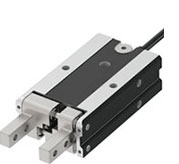
  • Digital Speed Control: Unlike fixed pneumatic speeds, the EC Series offers precise digital tuning for your process.
  • Space Savings: Same size as traditional small air cylinders, with equivalent force output.

IAI EC Series Wire GripperApplications range from PCB assembly and medical equipment manufacturing to robotic grippers and miniature linear actuators. The EC Series is also ideal for cleanroom applications, where avoiding air exhaust is critical.

If you’re looking to improve efficiency, precision, and ease of integration in your automation system, it may be time to consider going air-free.


Learn More about the EC Series Wire Cylinders

Ready to upgrade?
Valin’s automation specialists can help you choose the right EC Series configuration for your exact needs — and ensure a smooth integration.

Talk to one of our experts today at (855) 737-4716 or fill out our online form to learn more. 

Ask A Motion Control Engineer

Complex Motion Challenges Made Simple

Have a tough motion application you’re trying to figure out? Wondering what the best actuator, motor, or motion control solution is for your system? We can help you with:

  • Product Demonstrations (live or virtual)
  • Sizing and Selection Assistance
  • Engineering Consultations
  • Proof of Concepts
  • Custom Solutions for OEMs


We’ll Help You Ask The Right Questions

To get the most out of your request, our motion engineers will typically ask the LOSTPED questions:

  • Load: What are you moving (mass, payload, Center of Gravity)?
  • Orientation: Horizontal, vertical, or angled?
  • Speed: What are your target speed and accelerations or decelerations?
  • Travel: What’s the stroke length or range of motion?
  • Precision: What’s the repeatability or accuracy requirement?
  • Environment: Temperature, dust, moisture, or cleanroom rated?
  • Duty Cycle: Continuous or intermittent? How often is it moving?

Not sure about all of these? No problem — our experts will help you fill in the gaps! 


Want to speak with a motion control engineer? Fill out the form below: 

What Happens After You Submit? 

  1. Engineer Follow-Up: A Valin engineer will review your information and reach out within a business day.
  2. Discussion & Refinement: We'll schedule a short meeting (remote or in-person) to clarify your needs.
  3. Mitigate Risks: We’ll help you figure out how to mitigate risks through demonstrations, proof-of-concepts and experience.
  4. Documentation & Support: If your project calls for it, you will receive drawings, Bills-of-Materials, videos and support for implementation. 


Prefer to Talk Now?
Call us at 800-774-5630 or email CustomerService@valin.com 
 

Q & A

+ Can I get a demo or proof of concept before buying an actuator or gantry?
Ask us! Some applications and products are much easier than others to show than others. Many times we can mockup the critical piece of a complex system that is otherwise difficult to develop a test for.
+ Are there any costs associated with conducting a Proof of Concept (POC)?
We invest our time and hardware into your applications. Depending on those costs and your requirements, we may propose an investment on your part as well.
+ What is the typical lead time to schedule a product demo or a Proof of Concept (PoC)?
This is highly dependent on the complexity of your requirements, the availability of the hardware required, and the time it takes to set it all up.
+ How long does a typical application-specific demo or Proof of Concept (PoC) usually take to complete?
Depending on your application’s requirements and complexity, this can be as short as a few minutes to hours or days long.
+ What kind of data and reports can we expect from a completed Proof of Concept (PoC)?

If the proof-of-concept is focused on motion performance, then graphs from the motor’s encoder can be provided. Other tests may include external sensors or video recordings.

+ Can we provide our own test fixtures or components for the demo or Proof of Concept (PoC) setup?

Yes! If you have hardware specific to your application, then we can consider using that in our testing.

+ What are the most common motion control mistakes and how can I avoid them in machine design?

The most common motion control mistakes we see in machine design are when people: