Enhancing Robotic Arms with Rollon's Rod Ends
Submitted by Corey Foster || Valin Corporation
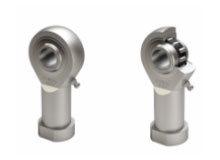
Robotic arms have become an integral part of modern automation, transforming industries ranging from manufacturing to healthcare.
Read MoreSubmitted by Corey Foster || Valin Corporation
Robotic arms have become an integral part of modern automation, transforming industries ranging from manufacturing to healthcare.
Read MoreSubmitted by Corey Foster || Valin Corporation
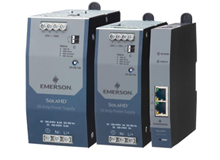
Unexpected system failures can disrupt operations, leading to costly downtime and repairs. To avoid these issues, predictive maintenance has become essential, enabling companies to foresee potential failures and address them proactively.
Read MoreSubmitted by Corey Foster || Valin Corporation
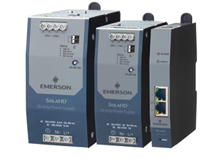
Unexpected power supply failures can lead to significant downtime, costly repairs, and loss of productivity. Critical applications need reliable power solutions that can ensure continuous operation, provide diagnostic data, and integrate seamlessly into their existing systems.
Read MoreSubmitted by Corey Foster || Valin Corporation
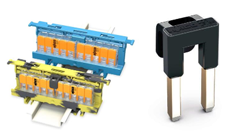
Discover the full potential of WAGO 221 Series with their range of carriers and jumpers.
Read MoreSubmitted by Corey Foster || Valin Corporation
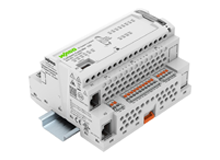
Having a reliable and versatile PLC is essential. Enter the WAGO Compact Controller 100, the go-to solution for powerful and efficient control. Designed with machine builders and plant floor tasks in mind, this compact device packs a punch, offering unparalleled flexibility and performance for applications of all sizes.
Read MoreSubmitted by Corey Foster || Valin Corporation
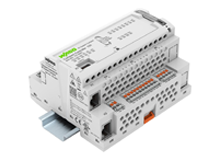
In the digital era, having a smart, connected device that bridges the gap between automation and IT is crucial. The WAGO Compact Controller 100 is more than just a PLC; it's a powerful IIoT information controller that brings your automation projects into the future.
Read MoreSubmitted by Corey Foster || Valin Corporation
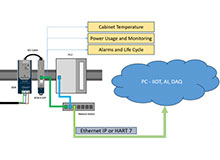
Some applications pose significant challenges that traditional wired IO-Link systems struggle to address effectively. This is where Cable Management Basics comes in.
Submitted by Corey Foster || Valin Corporation
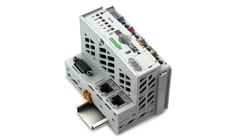
Allows for quick expansions, reductions, and changes in manufacturing and process engineering.
Read MoreSubmitted by Corey Foster || Valin Corporation
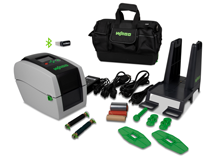
Are you looking to streamline your marking process while saving both time and money? Meet the WAGO Smart Printer, the industry’s most versatile and economical printing solution. This powerhouse device is designed to handle all your marking needs with ease and efficiency.
Read MoreSubmitted by Corey Foster || Valin Corporation
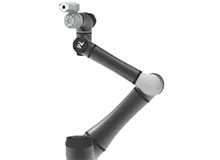
Techman AI Cobot series is a revolutionary family of collaborative robots that bring the power of AI and vision technology directly to your production floor.
Read MoreSubmitted by Corey Foster || Valin Corporation
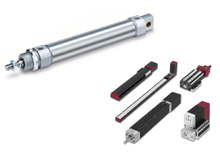
Designed to replace conventional pneumatic cylinders, ELECYLINDERS offer precise control, reduced cycle times, and enhanced reliability.
Read MoreSubmitted by Corey Foster || Valin Corporation
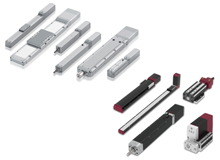
IAI has two lines of products that are meant to replace pneumatics, the ROBO Cylinders and the ELECYLINDERS. This page shows the general differences between the two lines so you can make the best decision for your application.
Read More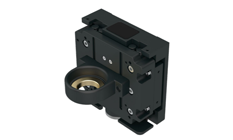
Precision and stability are no longer just desirable in many high-tech applications; they’re essential. Whether you’re in life sciences, semiconductor, metrology, or any field where dynamic focusing and ultra-fast settling times are critical, the ability to control positioning down to the nanometer level can dramatically improve your results.
Read MoreSubmitted by Yokogawa
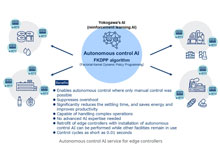
How many of your plant processes still depend on operator tribal knowledge? Any of those operators retiring soon? Yokogawa's e-RT3 Plus utilizes Factorial Kernel Dynamic Policy Programming (FKDPP) for accelerated machine learning. It can control and autonomize areas of plant operations that have been beyond the capabilities of existing control methods and have up to now necessitated manual operation.
Read MoreSubmitted by Jason Gaines || Valin Corporation
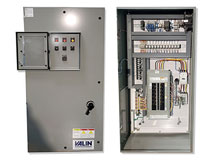
How can you be sure that a control panel you are purchasing from a builder meets the quality standard you need? After all, it needs to be built both correctly but more importantly, safely. Learn more in the blog below.
Read MoreSubmitted by Mitsubishi and Corey Foster, Valin

In industrial automation, preventive maintenance is crucial for minimizing downtime and extending the lifespan of machinery. Mitsubishi Electric offers advanced diagnostic functions for mechanical drive components and servo amplifiers to ensure optimal machine performance.
Read MoreSubmitted by Mitsubishi and Corey Foster, Valin

In the rapidly evolving world of industrial automation, predictive maintenance is key to minimizing downtime and maximizing efficiency. Mitsubishi Electric’s cutting-edge AI technology, Maisart, integrated with their servo amplifiers, provides a robust solution for predictive maintenance, helping detect early signs of machine failure.
Read MoreSubmitted by Mitsubishi and Corey Foster, Valin
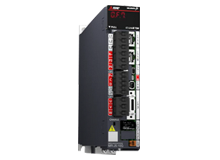
Mitsubishi Electric’s unique AI technology, Maisart, enables predictive maintenance and monitors operation status through servo amplifiers that detect early signs of machine failure.
Read MoreSubmitted by Mitsubishi and Corey Foster, Valin
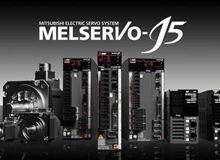
In mechanical systems, backlash is the clearance or lost motion between parts, often due to manufacturing imperfections. This gap causes positioning errors, which can degrade machine performance.
Read MoreSubmitted by Mitsubishi and Corey Foster, Valin
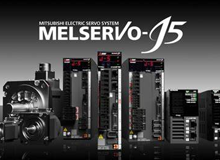
What is Backlash? In mechanical engineering, backlash (sometimes called lash, play, or slop) is a clearance or lost motion in a mechanism caused by gaps between parts. It can also be defined as an angle or distance through which any part of a mechanical system may move in one direction without applying force or motion to the next part.
Read More
As a heavily marketed and “new” technology, there are a lot of misconceptions about collaborative robots. In reality, we can’t even call them “new” anymore, but they are still new and unfamiliar to a lot of people. And those are the people who probably most need to look at using cobots. Let’s debunk some of the common myths surrounding collaborative robots to gain a clearer understanding of their true potential.
Read More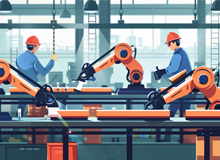
We often hear about rising labor costs, worker shortages, and people unwilling to work. The solution? Automation. Collaborative robots (cobots) are an excellent first step, especially for businesses new to automation. They offer several key advantages.
Read More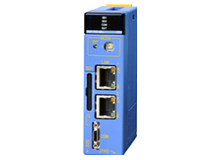
When it comes to industrial automation, the choice of hardware can significantly impact your system’s performance, reliability, and cost-efficiency. Standard Industrial PCs (IPCs) have been widely used, but they often come with several limitations. Yokogawa’s e-RT3 Linux-based model presents a superior alternative, addressing these limitations while offering robust and flexible solutions tailored for industrial environments.
Read More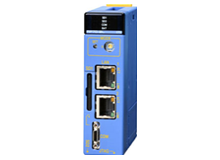
In the realm of industrial automation, choosing the right controller can make a significant difference in the efficiency, flexibility, and performance of your systems. While standard Programmable Logic Controllers (PLCs) have been the go-to for many years, their limitations are becoming increasingly apparent in today's fast-paced industrial environments. Yokogawa's e-RT3 and FA offer advanced alternatives that address these limitations and provide superior performance and capabilities.
Read More