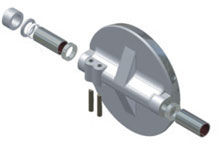
Jamesbury Wafer-Sphere? Butterfly Valve Compared to Rubber Lined Butterfly Valve
Submitted by Don Wolff
The Jamesbury high-performance valve is a heartier concept than the rubber-lined version. The term 'high performance' when considering the butterfly valve means the valve will take full ANSI pressure ratings, shuts off 'bubble tight', has higher temperature ratings, and, through the use of design and materials, has a much higher cycle life (extending into the millions of cycles without failure or leakage).
Read More
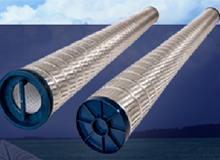
Fulflo? HF Depthflo? Filter Cartridges with High Capacity Pleated Microglass Filters are Optimized for High-Flow and High Dirt-Holding
The Fulflo? HF Depthflo? microglass pleated filter cartridges are offered in 6" diameter x 80" lengths. The high surface area filter media is supported with a tin-plated steel core and outer cage utilizing an external O-ring seal with a closed cap.
Read More
GasShield? PENTA? Hiflow Gas Filters
GasShield? PENTA? filters offer the high flow and low ΔP of Teflon?, but with a 100% nickel filter element. This design reduces filter element surface area, resulting in lower levels of moisture retention and faster purge time.
Read More
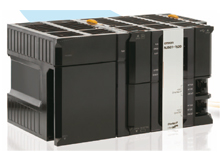
Entry Level Sysmac Controller with SQL Database Connectivity
These new models connect directly to the database and accelerate leveraging real-time data for productivity improvement, predictive maintenance, and quality traceability at production sites.
Read More
Avoiding Supply Chain Related Equipment Downtime
Unplanned downtime is very expensive for any company— and emergency downtime can be disastrous for profits and continued viability. Emergency downtime (when something has gone seriously, catastrophically wrong) can cost five times as much as downtime for planned maintenance.
Read More
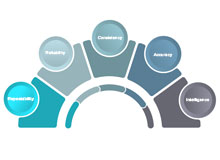
The 5 Pillars of Optimal System Design
Designing an effective and long-lasting system—one that will not only meet current requirements but will also provide exceptional performance and quality in the future—is a challenge that many manufacturers struggle to meet. This article looks at how to design an optimal system. Learn more
Read More
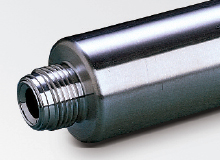
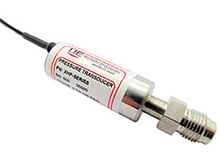
XHP Series High Purity Transducer - Designed for Accurate, Reliable, Long-Term Sensing of Process Gases
Precision Sensors XHP Series "High Purity" Transducer is designed for accurate, reliable, long-term sensing of process gases used in the manufacturing of semiconductor products. LED status light verifies that the transducer is operating correctly. Color band labels are provided with the unit to allow the installer to mark and identify the measured gas.?
Read More
Benefits of Readily Available & Properly Equipped Outsourced Field Service Technicians
However well-designed your system may be, eventually, it will fail. And odds are that it will fail at the worst possible time—late in the evening, on a Sunday, or a public holiday, whenever you are least prepared to deal with unexpected downtime.
Read More
5 Steps to a Safer Workplace
In 2008, manufacturers lost $53 billion in productivity due to employee accidents, according to the U.S. Department of Labor Statistics.
Read More
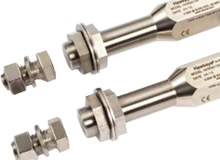
Proximity Sensors for Linear Valve Position Sensing
The explosionproof Hawkeye, with its stainless steel enclosure, is designed for service in harsh process environments. It features a solid state proximity sensor which is encased in a shock absorbent urethane potting material.
Read More
The Long-Term Benefits of Optimizing Your Systems
Why should a company invest time and resources into optimizing their systems when the systems they currently use are working perfectly well?
Read More
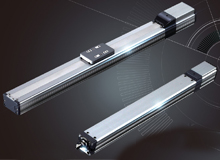
ROBO Cylinder RCP5: Convenience, Cost and Simplicity
The innovative battery-less absolute encoder operates through the combination of gears recognizing the rotational position data, which eliminates the need for a battery (and battery replacement) that is normally required for a conventional absolute encoder.
Read More
Optimized Design Means a Safer Workplace
Workplace safety is a top priority throughout U.S. industry, but how can we ensure that work spaces are as safe as they possibly can be?
Read More
WIKA Announces the New MH-3 Pressure Transmitter for Mobile Working Machines
Determining problems and errors in the field just got easier with the new WIKA MH-3 pressure transmitter for mobile working machines. WIKA Instrument, LP captures the latest pressure sensor technology with the addition of the diagnostic function in the new MH-3 pressure transmitter.
Read More
Bridging the Knowledge Gap
Industry recruiters are aware of an increasing knowledge gap in the workforce between retiring baby boomers and the new recruits hired to replace them.
Read More
Introduction to Pressure Part II: Velocity, Flow Rate and Reaction Force
Submitted by Russ Rochambeau, Engineering Manager, IFPS Hydraulic Specialist
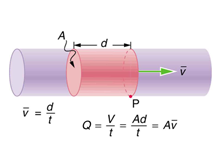
In order to determine the Flow Rate represented as Q, we must define both the volume V and the point in time it is flowing past represented by t, or Q = V/t. Additionally, Flow rate and velocity are related by the equation Q = Av where A is the cross-sectional area of flow and v is its average velocity.
Read More
Prism PI - Intelligent Valve Communication and Control for Linear Applications
Submitted by StoneL
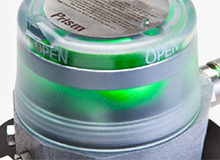
The Prism PI integrates an advanced position sensing system and integral pneumatic control for sanitary diaphragm and other linear applications. Compact and durable, the PI is suited for corrosive, heavy washdown, and hazardous areas.
Read More
How Undersized Return Lines can Cause Problems for Hydraulic Prop Valves
Submitted by Triston Hyatt
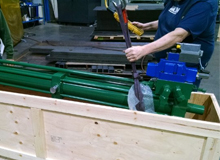
Many wood mills use hydraulic positioners like the one in the picture above.? Sometimes they try to increase the speed of these cylinders by replacing the prop valves mounted on the cylinder with valves with higher flow rates.
Read More
Avoid the Costs of Poor On-the-Job Training
Many U.S. industries are struggling as there are simply not enough experienced workers to go around. With the loss of expertise and knowledge that has accompanied the retirement of so many of the baby-boomer generation; today's organizations are struggling to fill the gaps in their workforce.
Read More
The Secret to Reducing MTTR and Increasing MTBF
A primary goal for all system design is to reduce downtime—and the most effective way to do it is by designing reliable systems. Mean time to recovery (MTTR) and mean time between failures (MTBF) are two useful metrics in evaluating the reliability of a system
Read More
How to Manage Your Equipment Maintenance Options
Whether you're a large production plant or a mobile, field-service operation, you should think carefully about what kind of maintenance plan you need for your equipment. Without fully functioning equipment, production halts, customers get frustrated and angry—and you lose money.
Read More
Next-Generation ROBO Cylinder? RCP6 Series Reduces Operation Time and Production Costs
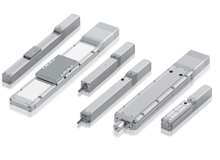
A wide variety of product types are in the new RCP6 series, which also include wide slider types and wide radial cylinder types, and no battery maintenance is required because there is no battery. Since home return is not required at equipment startup or after an emergency stop, this feature reduces operation time and production costs.
Read More
Using ROI to Prove the Benefit of Your Optimal System Design
Securing the go ahead for a system upgrade can be difficult in a competitive work environment, where every cost must be accounted for and validated. Getting your project noticed and approved when it's lost among a sea of competing projects—each one making a claim on finite resources—can seem an impossible task.
Read More
Fluid Power - Introduction to Pressure: The Basics
Submitted by Russ Rochambeau, Engineering Manager, IFPS Hydraulic Specialist, Valin Corporation
When discussing fluid power, pressure is the basis for producing any kind of work. Work cannot be achieved without pressure. To understand the finer points of fluid power, one must first understand the concept of pressure
Read More