Controlling Compressor Vibration and Surge
Submitted by Jim Slama || Valin Corporation
Controlling vibration and surge is one of the most critical aspects of keeping centrifugal and reciprocating compressors up and running. If improperly monitored and maintained, these types of compressors can experience frequent functional issues and ultimately shorten their life span.
Read More
Modern Tools for Sizing Control Valves and Actuators
Submitted by Jon Monsen || Valin Corporation
Valve sizing and proper application of control valves have always gone hand-in-hand. However, the tools available to valve users have changed and improved significantly over time.
Read More
Best Practices: Pipe and Valve Selection for a Cooling System
Submitted by Ray Herrera || Valin Corporation
When selecting the pipes and valves for a cooling system, it is important to understand the options available—and the possible outcomes associated with each selection. Many factors can impact the effectiveness, longevity, and quality of the overall cooling system. Learn more.
Read More
The ABCs of VFDs
Submitted by Kevin Goodsell || Valin Corporation
Inside of plants today, AC motors are becoming the industry standard. Many plants are shifting to AC motors from hydraulic motors or DC motors when powering heavy loads, which were more popular in the past. This shift can be attributed to a variety of reasons and most have to do with cost.
Read More
United Electric Controls | HART Transmitters with Switching
United Electric Controls has introduced a unique new family of HART capable transmitters that provides programmable switching functionality for industrial process monitoring applications. The One Series 1XTXSW transmitter line is the first to integrate HART 7 compatible 4-20 mA output. Lean more.
Read More
Workplace Safety Still Needs a Human Component
Workplace safety is—or should be—a primary focus of every organization, regardless of whether we're talking about a classroom, an office, a manufacturing facility, or an oil rig. Employees deserve a workspace that is as safe and secure as it can possibly be.
Read More
Part IV: Keys to Effective Valve Sizing & Selection
Submitted by Jon Monsen Ph.D., PE // Flow Control Network Magazine
This is Part IV in a four-part series based on the contents of the new textbook, "Control Valve Application Technology, Techniques and Considerations for Properly Selecting the Right Control Valve."
Read More
Cavitation… What you need to know
Submitted by Russ Rochambeau, Valin Corporation
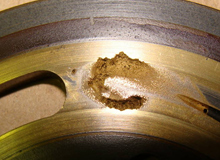
Cavitation is the 2nd leading cause of a pump system failure. It's for this reason that a full understanding of what cavitation is, how it is caused, and how it can be prevented is critical in the fluid power industry.
Read More
Part III: A Guide to Installed Gain | Control Valve Sizing
Submitted by Jon Monsen Ph.D., PE // Flow Control Network Magazine
In order to get good control with stability throughout the full range of required flow rates, one must use a control valve that has an installed flow characteristic that is linear, or at least as close to linear as possible in most systems.
Read More
Multi-Megawatt Electric Heating System Solutions | PROCESSWest
Submitted by Jamie Zachary | PROCESSWest
Tasked with increased demand for high power output, many operators in North American sectors such as power generation, oil and gas, petrochemical, and chemical have been challenged by low-voltage solutions and their associated logistical challenges.
Read More
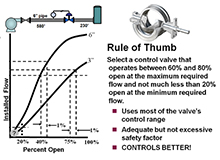
Control Valve Sizing 101 | Rules of Thumb
Submitted by Jon Monsen, Ph.D., P.E., Control Valve Technology Specialist at Valin
When control valve professionals talk about "control valve sizing," they really mean the entire process of selecting the valve that will do the best job of controlling the process. Selecting the right size valve is an important part of the process, but there are other equally important considerations as well.
Read More
Part II: A Guide to Control Valves and Process Variability
Submitted by Jon Monsen Ph.D., PE // Flow Control Network Magazine
This is Part II in a four-part series based on the contents of the new textbook, "Control Valve Application Technology, Techniques and Considerations for Properly Selecting the Right Control Valve."
Read More
Part I: A Guide to Control Valves and Process Variability
Submitted by Jon Monsen Ph.D., PE // Flow Control Network Magazine
This article discusses the importance of selecting the correct flow characteristic and correctly sizing the valve in order for the valve to properly control the process.
Read More
Noise from Cavitation: Bad for Control Valves and Equipment
Submitted by Jon Monsen and Peter Jessee // Valve Magazine
Certain frequencies of sound can play havoc on industrial equipment. When control valves are not selected appropriately, there is an increased risk for cavitation, which causes high noise and vibration levels, resulting in very rapid damage to the valve's internals and/or the downstream piping.
Read More
Best Practices in CONTROL
Submitted by Jon Irvine
Considering the number of variables, gaining precise control of a process heating application can be a difficult task. In industries with a high demand for consistent quality, controlling the temperature of a substance from the start to the finish of a process is an absolute necessity. Learn more.
Read More
Best-Practices for Level Measurement Device Selection
Submitted by Brian Sullivan
In the chemical processing industry, a significant percentage of measurement devices are not correctly matched to their application. This leads to decreased quality and consistency in their operation.
Read More
How Gauges Can Help Prevent Costly Loss of Containment
Submitted by WIKA Instrument Guru
Loss of containment is one of the costliest things that can go wrong at a plant. Accordingly, smart enterprises employ a variety of measures that ensure loss of containment just doesn't happen or when it does, the adverse circumstances are kept to a minimum.
Read More
Advanced Control Methods as 'Commodities'
Submitted by Renee Robbins Bassett, Featured in Automation World Magazine
Advanced Process Control (APC) methods used to be so advanced as to be esoteric- too complex and unusable except by a few high-level experts. Today, however, it seems APC is little talked about for an entirely different reason: It's become a commodity.
Read More
Heat Trace: Importance of Temperature Sensor Placement
Submitted by Jon Irvine, Featured in Automation.com Magazine
A temperature sensor is a key component of any process heating application as it provides temperature feedback about the process, which can be used to monitor or control the process.
Read More