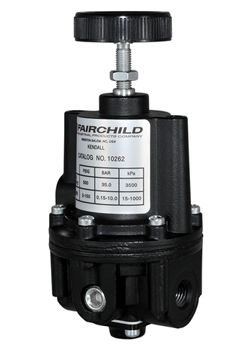
 Rotork Fairchild Model 10 is a precision pressure regulator designed for applications that require high performance and accurate process control. Stability of regulated pressure is maintained under varying flow conditions through the use of an aspirator tube which adjusts the supply valve in accordance with the flow velocity.
The Model 10 Series regulator uses mechanical feedback force balance principals to control the movement of the Valve Assembly that controls the output pressure. When the regulator is adjusted for a specific set point, the downward force of the Range Spring moves the Diaphragm Assembly downward. The Supply Valve opens and allows air to pass to the Outlet Port. As the set point is reached, the downward force exerted by the Range Spring is balanced by the force of the downstream pressure that acts on the Diaphragm Assembly. The resultant force moves the Supply Valve upward to reduce the flow of air to the Outlet Port.
Outlet pressure is maintained as a result of balance between forces acting on the top and bottom of the Diaphragm Assembly.
Features
Model 10 Pneumatic Precision Regulator Features
- High control sensitivity of 1/8" water column - highest accuracy pressure regulator available
- Pressure balanced supply valve prevents supply pressure changes from affecting the setpoint
- Separate control chamber isolates diaphragm from flow to eliminate hunting and buzzing
- Aspirator tube design compensates downstream pressure drop under flow conditions
- 9 output pressure ranges from 0-2 psi, 0-0.15 BAR, 0-15 kPa, up to 5-400 psi, 0.3-28 BAR, 35-2800 kPa - select the range best suited for your application
- 40 SCFM, 68 m3/hr flow capacity ? Check valve option permits backflow of downstream pressure
- No yellow metals option facilitates the handling of harsh media ? Typical Part Numbers are 10212, 10222, 10232, 10242, 10252, 10262, 10272, 10282, 10292, 10233, 10243, 10253, 10263, 10273, 10283, 10293
Specifications
Model 10 Pneumatic Precision Regulator Specifications
| Specification | Value |
|---|---|
| Supply Pressure | 500 psig [35.0 BAR] (3500 kPa) Maximum |
| Flow Capacity | 40 SCFM (68 m3/hr) @ 100 psig [7.0 BAR] (700 kPa) supply and 20 psig [1.5 BAR] (150 kPa) setpoint |
| Exhaust Capacity | 5.5 SCFM (9.35 m3/hr) where downstream pressure is 5 psig [.35 BAR] (35 kPa) above 20 psig [1.5 BAR] (150 kPa) setpoint |
| Supply Pressure Effect | Less than 0.1 psig [.007 BAR] (0.7 kPa) for 100 psig [7.0 BAR] (700 kPa) change in supply pressure |
| Sensitivity | 1/8 in Water Column [0.31 mBAR (0.031 kPa)] |
| Ambient Temperature | -40°F to +200°F (-40°C to 93.3°C) |
| Hazardous Locations | Acceptable for use in Zones 1 and 2 (gas); Groups IIA & IIB and Zones 21 & 22 (dust) |
| Materials of Construction |
|
Options
Model 10 Pneumatic Precision Regulator Options
| Option Code | Description |
|---|---|
| B – Low Bleed | Reduces the bleed rate below that of a standard unit and can be used when bleed or air consumption is an issue. A reduction in sensitivity will result from the lower bleed rate. |
| L – Low Flow | Increases the bleed rate above that of a standard unit to improve response in low flow applications. |
| C – Check Valve | Internal check valve that permits rapid backflow of downstream pressure through the supply line when supply pressure is removed. |
| N – Non-Relieving | Includes no relief function or continuous bleed. Units with this feature must operate with a continuous downstream flow to regulate properly and prevent output from equalizing with supply pressure. |
| D – Relieving, No Bleed | Provides relieving function without continuous bleed. A reduction in sensitivity will result from the no-bleed feature. |
Q & A
Model 10 Pneumatic Precision Regulator Q & A:
The sensitivity is 1/8 in water column [0.31 mBAR (0.031 kPa)].
The supply pressure effect is less than 0.1 psig [0.007 BAR] (0.7 kPa) for a 100 psig [7.0 BAR] change in supply pressure.
Downloads
Download Rotork Fairchild Model 10 Pneumatic Precision Regulator Datasheet
Contact us at (855) 737-4714 to learn more or fill out our online form.