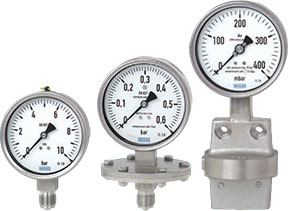
 With decades of experience, global manufacturing reach, and unmatched engineering expertise, WIKA offers one of the broadest and most configurable pressure gauge portfolios in the world. From standard industrial tasks to the most demanding chemical, petrochemical, or power-generation applications. Whatever your media, pressure range or environmental challenge, there is a WIKA gauge engineered to meet it. Combine that with a full suite of accessories, custom materials and global support, and you get not just a pressure instrument, but a reliable measuring solution built for decades of service.
Why WIKA?
Why Choose WIKA Pressure Gauges
Proven global quality and consistency. WIKA manufactures instruments in multiple countries under a unified, ISO 9001-certified quality system.
In-house design & expertise. WIKA develops its own core measuring elements (Bourdon tube, diaphragm, capsule) and pairs them with precision “Swiss-style” movements, a combination that yields robust, long-lasting instruments.
Wide product breadth + customization. From standard gauges to special materials, safety versions, and custom configurations, WIKA covers virtually all industrial measurement requirements worldwide.
Reliability in harsh conditions. Many WIKA gauges are built from stainless steel or special alloys and, where needed, can be liquid-filled or delivered with overload safety.
Comprehensive support. WIKA and its partner Valin offer value-added services including calibration, custom mounting, instrument integration, accessories, and full lifecycle support.
Gauge Types
WIKA's Technology & Gauge Types
Bourdon Tube Gauges: The workhorses for many general pressure measurement tasks. WIKA’s stainless-steel Bourdon gauges offer excellent stability over repeated pressure cycles, strong resistance to shock, and cover extreme pressure ranges (up to ~20,000 psi / 1,600 bar on some models) depending on size and version.
Diaphragm Gauges: Used when Bourdon gauges reach their limits. Diaphragm-based instruments excel at measuring very low pressures (e.g., from a few mbar or even inches water column) and offer significantly improved overload protection — up to several times full-scale pressure — compared to standard Bourdon gauges.
Capsule / Low-Pressure Gauges: For applications requiring precise measurement of low pressures or vacuum/compound ranges. WIKA offers capsule-element instruments for those conditions.
Materials
Materials, Ranges & Options
Material options: For neutral media (air, water, oil), standard plastic-case with copper-alloy internals can suffice. For hydraulic, chemical or corrosive media — stainless steel (304 or 316), or special materials/coatings (PTFE, Hastelloy, Monel, Titanium, etc.) provide the resistance needed.
Case filling (dry or liquid): Liquid-filled gauges significantly improve readability under vibration, dampen pulsations, protect internals, prevent lens fogging/icing, and extend service life — especially under heavy-duty, dynamic conditions.
Accuracy classes / precision: WIKA offers standard industrial gauges with typical accuracy classes (e.g., 1.6 % or 1.0 % for stainless or chrome-steel instruments), and higher-precision/test gauges with even tighter tolerances (e.g., 0.6 %, 0.25 %, 0.1 % depending on scale and range).
Wide pressure range coverage: From very low pressures (e.g., few mbar / inches water column) up to extremely high pressures (hundreds to thousands of bar), WIKA instruments cover a broad spectrum of measurement needs.
Special configurations: Safety versions (e.g., with blow-out plugs), overload safety, custom materials, special process connections, and optional electrical outputs/switch contacts.
Q & A
WIKA Pressure Gauges Q & A
Choosing the right gauge depends first on what media you’re measuring and the pressure range.
For general industrial applications with stable, clean fluids (air, water, oil) and standard-to-high pressure ranges, WIKA’s Bourdon-tube gauges are often ideal. They offer broad range coverage and rugged reliability.
If you’re measuring low pressures, vacuum, or need greater sensitivity — or if the media is corrosive, viscous, or particulate-laden — then a diaphragm (or capsule) gauge may be more appropriate, because its sensing element better tolerates challenging media and is less prone to clogging or damage.
You also need to account for environmental conditions, compatibility of the process fluid with wetted parts, and required accuracy — WIKA offers different materials and configurations to match those needs.
In short: for standard pressures & clean media → Bourdon; for low pressure, aggressive media or special fluids → diaphragm/capsule.
Best practice is to select a gauge whose full-scale pressure range is roughly 2× the highest normal operating pressure of your system. That gives margin for pressure spikes and ensures longevity.
For accuracy: many standard industrial gauges are fine for everyday monitoring, but if you need tight measurement tolerances or precision control, choose gauges with higher accuracy classes (as offered by WIKA — ranging from industrial-grade to test-grade, depending on the model).
Also, if your system experiences significant pulsation, vibration, or fluctuating loads, it’s often safer to overspec the gauge rather than rely on the bare minimum — and consider a liquid-filled gauge for stability.
Material compatibility is critical. For clean, non-aggressive media (like air, water, standard oils), standard brass/copper-alloy gauges may be suitable.
However, when dealing with corrosive fluids, acidic media, slurries, or chemically aggressive substances, you should choose gauges with stainless steel, Monel?, Hastelloy?, or other specialty wetted parts. In many such cases, adding a diaphragm seal is recommended to isolate the process fluid from the gauge internals — preventing corrosion, clogging, or contamination.
Additionally, for harsh environments (vibration, pulsation, temperature extremes), WIKA offers liquid-filled case options and different mounting/connection styles to maximize durability and reliability.
Yes — WIKA gauges can be configured to handle challenging operating conditions, but the right options must be selected:
For systems with vibration or pressure pulsation, choose a liquid-filled gauge (e.g., glycerin, silicone, or inert oil) — the fill fluid dampens needle flutter and protects internal mechanisms.
If the media is corrosive, contains particles, or may crystallize, pair the gauge with a diaphragm seal or isolating accessory. That prevents direct contact between harmful media and the gauge’s sensing element, increasing service life.
For extreme temperatures — e.g., steam or high-heat media — consider additional protective accessories like pigtail siphons, cooling elements, or remote mounting via capillary tubing if needed.
Finally, always ensure the gauge is installed per manufacturer recommendations (correct mounting position, compatible process connection, and proper maintenance) to guarantee longevity.
Purchasing WIKA gauges through Valin offers several advantages beyond just getting the instrument:
You get access to expert support, including assistance with selecting the correct gauge type, pressure range, materials, mounting style, or accessories — helpful if your process conditions are complex or non-standard.
Buying from a trusted distributor helps ensure you receive genuine WIKA products, full traceability, and warranty compliance — which is critical for process safety and regulatory compliance.
These benefits make Valin more than a supplier — we’re a partner in helping you design, install, and maintain pressure measurement systems that work reliably under real-world industrial conditions.
Downloads
Download WIKA's Pressure Gauges for the Process Industry Brochure
Talk to one of our process control experts today at (855) 737-4714 or fill out our online form to learn more.