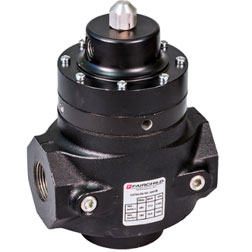
Model 200 Volume Booster from Rotork Fairchild

Rotork Fairchild Model 200 Volume BoosterThe Fairchild Model 200 pneumatic volume booster reproduces a pneumatic signal in a 1:1 ratio. It is ideally suited for systems that require input isolation or increased forward flow capacity.

Operating Principles

When signal pressure on the top of the signal diaphragm creates a downward force on the diaphragm assembly, the supply valve opens. Output pressure flows through the outlet port and the aspirator tube to the control chamber to create an upward force on the bottom of the control diaphragm. When the setpoint is reached, the downward force of the signal pressure that acts on the top of the signal diaphragm balances with the upward force of the output pressure that acts on the bottom of the control diaphragm and closes the valve to maintain the setpoint.

When the output pressure increases above the signal pressure, the diaphragm assembly moves upward to close the supply valve and open the exhaust valve. Excess output pressure exhausts through the vents in the side of the unit until it reaches the setpoint.

Features

Model 200 Volume Booster Features

  • Control sensitivity to 1" water column variation
  • Large supply and exhaust valves provide high forward and exhaust flows
  • A balanced supply valve minimizes the effect of supply pressure variation
  • An aspirator tube minimizes downstream pressure drop under flow conditions
  • A separate control chamber isolates the diaphragm from the main flow to eliminate hunting and buzzing
  • Optional increased sensitivity configuration with larger control diaphragm for more precision control at low setpoints
  • Unit construction lets you service the Model 200 without removing it from the line
  • Mounting bracket is available

Specifications

Model 200 Volume Booster Specifications

  • Maximum supply pressure: 250 psig, [17.0 bar], (1700 kPa)
  • Flow capacity: 1800 SCFM (3058 m3/hr) @ 150 psig, [10.0 bar], (1000 kPa) supply, 20 psig, [1.5 bar], (150 kPa) setpoint
  • Exhaust capacity: 65 SCFM (110.5 m3/hr) where downstream pressure is 5 psig, [0.35 bar], (35 kPa) above 20 psig, [1.5 bar], (150 kPa) setpoint
  • Maximum signal or output pressure: 150 psig, [10 bar], (1000 kPa)
  • Supply pressure effect: Less than 0.5 psig, [0.035 bar], (3.5 kPa) for 100 psig, [7.0 bar], (700 kPa) change in supply pressure
  • Sensitivity: 1” (2.54 cm) water column
  • Ambient temperature: -40 to +200 oF, (-40 to +93.3 oC)
  • Materials of construction:
    • Body and housing: Aluminum
    • Trim: Aluminum, stainless steel, zinc plated steel, brass
    • Diaphragms: Nitrile on polyester

Dimensions

Model 200 Volume Booster Dimensions
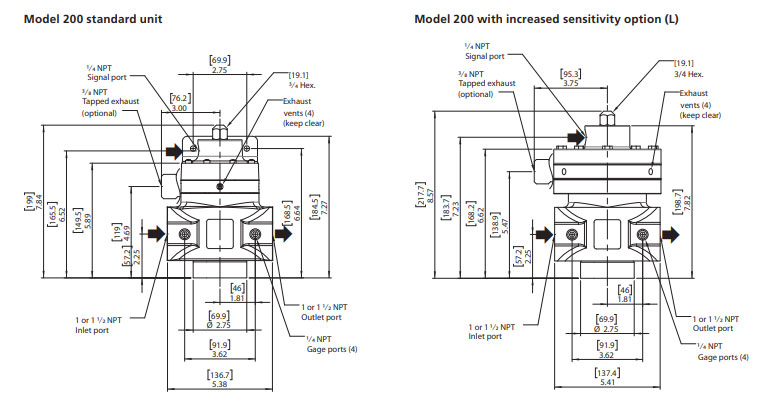
Rotork Fairchild Model 200 Volume Booster Dimensions

Q & A

Q&A Section with Expand/Collapse Icons

Model 200 Volume Booster System Q & A

+ What is the Model 200 and how does it benefit my industrial system?
The Fairchild Model 200 is a high-capacity pneumatic volume booster designed to reproduce a pneumatic signal at a 1:1 ratio while delivering very high forward flow and exhaust capacity—a key benefit for industrial systems that require input isolation or rapid actuator/valve movement. It uses a force-balance system to control supply and exhaust valves, and features large supply/exhaust ports, a balanced supply valve to minimise supply‐pressure variation, an aspirator tube to minimise downstream pressure droop, and a separate control chamber to eliminate hunting and buzzing. This makes it especially suited for automation, process control, power generation, oil & gas and water/wastewater systems across North America and beyond.
 
+ What are the key specifications I need to verify for fit and performance?
Important specifications for the Model 200 include a forward flow capacity of up to 1,800 SCFM (≈ 3,058 m3/hr) which equates to a Cv of approximately 18 in forward flow mode. It handles supply pressures up to around 250 psig (17.0 bar) and output (signal) pressures up to about 150 psig (10.0 bar). Sensitivity can reach 1” of water column (≈ 2.54 cm) for precision control. Materials of construction include an aluminum body/housing, nitrile on Dacron diaphragms, and trim material of brass, zinc-plated steel or stainless steel depending on option. To ensure fit you should check your system’s required flow, signal and supply pressures, ambient temperature (Model 200 is rated ?40 °F to +200 °F/?40 °C to ≈ 93?°C) and port/thread sizes.
+ How do I select, install and maintain the Model 200 in my system?
Selection begins with determining your system’s signal pressure, required output/actuator pressure, flow demand, and the supply pressure available. Because the Model 200 reproduces a 1:1 signal-to-output ratio, you’ll want to ensure the signal from your positioner or I/P transducer matches the desired output pressure of your actuator or valve. The high flow capacity means you can use it for large cylinders or valves where speed of actuation matters. Installation best practices: ensure the air supply is clean and free of entrained liquids/contaminants (the datasheet emphasises oil-free air ahead of the booster). Mounting can be in any position, with recommended bracket (e.g., Mounting Bracket kit 10311) for stability. Avoid undersized piping and verify correct port orientation. For maintenance: the unit is designed so you can service it without removal from the line. Diaphragms should be checked periodically, exhaust vents kept clear, and contamination avoided.
 
+ What are the typical applications and benefits of using the Model 200 in automation systems?
The Model 200 is ideal in applications requiring high flow and fast response—such as large pneumatic valve actuators in oil & gas, chemical processing, power generation, and water/wastewater treatment where quick open/close action is required. Because it provides a direct 1:1 signal replication with very high flow capacity and precision sensitivity, it enhances system responsiveness, reduces actuator lag, and improves control stability. The aspirator tube and separate control chamber reduce droop and eliminate hunting/oscillation, which are key benefits in demanding industrial control environments. Its robust construction and field-serviceable design also lower lifecycle maintenance costs and downtime.  
 
 
+ When should I choose a different model instead of the Model 200?
While the Model 200 offers high flow and robust performance, there are conditions where a different model might be more appropriate. For example: if your application requires back-pressure or relief operation (rather than forward flow boosting or signal recreation), you might select the Model 20BP or a back-pressure variant. If your system requires even higher flow or larger Cv than 1,800 SCFM (for extremely large actuators or very fast cycling) then the Model 200XLR or other ultra-high-flow variants should be considered. If you are working in corrosive environments, extreme temperatures or special exotic materials are needed, you might require a model with special construction or materials. Always match the booster’s flow, pressure, mode (forward vs back-pressure), and materials to your specific system requirements to avoid undersizing or performance issues.


Downloads

Download Rotork Fairchild Model 200 Pneumatic Volume Booster Datasheet

Call us today at (855) 737-4714 to learn more, or fill out our online form and someone will get back to you.

 
You were tireless in your support and it will not be forgotten!
 
When we needed technical assistance and application support, Valin was there for us. Their knowledgeable engineers saved us an invaluable amount of time, helping us get up and running quickly. We are very happy with their services.