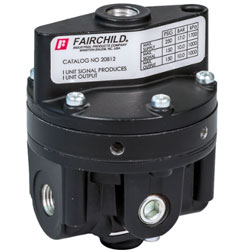
Model 20 Volume Booster from Rotork Fairchild

Rorork Fairchild Model 20 Volume BoosterThe Model 20 Volume Booster is a smaller pneumatic device capable of high flow and exhaust capacity. This device uses a force balance system to control the movement of the supply and exhaust valves.

Operating Principles

The Model 20 volume booster is a pneumatic device capable of high flow and exhaust capacity. This device uses a force balance system to control the movement of the supply and exhaust valves.

At the setpoint, the force due to signal pressure that acts on the top of the upper diaphragm balances with the force due to output pressure acting on the bottom of the lower diaphragm.

Features

Model 20 Volume Booster Features

  • A pneumatic input signal accurately controls output pressure
  • A balanced supply valve minimizes the effects of supply pressure variation
  • Aspirator tube compensates downstream pressure droop under flowing conditions
  • Optional adjustable bypass needle valve option includes a bubble-tight exhaust valve, allows tuning for optimum dynamic response (1:1 ratio only), and cycle-free operation with valve positioners
  • Optional fixed negative bias for pneumatic signal devices that cannot be adjusted to zero signal pressure
  • A separate control chamber isolates the diaphragm from the main flow to eliminate hunting and buzzing
  • Unit construction allows servicing without removal
  • Mounting bracket available - easy installation in the field
  • Suitable for use in all Canadian territories and provinces

Specifications

Model 20 Volume Booster Specifications
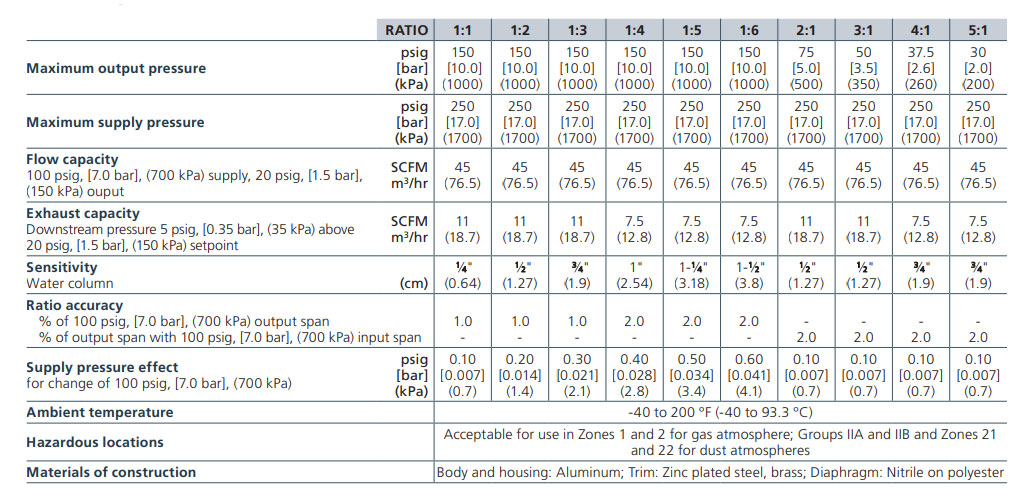
Rotork Fairchild Model 20 Volume Booster

Dimensions

Model 20 Volume Booster Dimensions

Rotork Fairchild Model 20 Volume Booster Dimensions


Q & A

Q&A Section with Expand/Collapse Icons

Model 20 Volume Booster Q & A

+ What are the main specifications of the Fairchild M20 Volume Booster, and is it suitable for my industrial control system?
The Fairchild M20 Volume Booster is a pilot-operated pneumatic device designed to amplify low-flow control signals into higher-flow output pressure for accurate valve actuation and control. It delivers approximately 45 SCFM (76.5 m3/hr) of flow capacity with a Cv of about 1.0 and supports maximum supply pressures up to 150 psig (10 bar), with some variants rated up to 250 psig (17 bar). The booster offers multiple signal-to-output pressure ratios, such as 1:1, 1:2, and 1:4, allowing flexibility for different downstream requirements. Its balanced supply valve minimizes the effects of supply pressure variation, while an aspirator tube compensates for droop, ensuring stable output. Built with a durable aluminum body, brass and zinc-plated steel trim, and Nitrile diaphragms, the M20 operates reliably in temperatures from -40 °F to +200 °F (-40 °C to 93 °C). This makes it ideal for medium-flow industrial applications where precise pneumatic control and dependable performance are essential.
 
+ How do I select the correct ratio and connection size for my application?
Selecting the right configuration for the M20 depends on your system’s signal and output pressure needs. Start by identifying your signal pressure—typically the output of a control valve positioner or I/P transducer—and your desired downstream output pressure. The pressure ratio should match those values; for instance, a 20 psig signal driving an 80 psig actuator requires a 1:4 ratio. The M20 is available in multiple ratios from 1:1 up to 5:1 and offers standard ?″ NPT or ?″ NPT ports. You should also confirm your supply pressure is within the model’s rated range and that the 45 SCFM flow capacity meets your actuator’s demand. If your application involves higher flow or pressure requirements, another Fairchild or Rotork model may be more appropriate. Finally, consider environmental conditions—ambient temperature, vibration, or hazardous areas—to ensure compatibility with your operating environment.
+ What installation and maintenance considerations should I know when installing the M20?

The M20 is designed for straightforward installation and long-term reliability. It can be mounted easily using an optional bracket, and most servicing can be performed without removing the device from the line, minimizing downtime. For optimal performance, ensure the pneumatic signal supply is clean and dry to prevent diaphragm wear or clogging. Proper exhaust routing is also essential—depending on the model, you may have a straight or tapped exhaust, both of which should be vented safely. Although the M20’s balanced supply valve reduces the impact of pressure fluctuations, maintaining a stable supply will yield the best results. It’s also recommended to periodically inspect the diaphragms and fittings for leaks and verify the response time to confirm the unit is performing as expected. Installing the booster close to the actuator will further enhance response speed and stability.

 
+ What are the typical applications and benefits of using the M20 in industrial automation systems?
The Fairchild M20 is widely used in industries such as oil and gas, chemical processing, water and wastewater treatment, and power generation. It is particularly effective in pneumatic control systems where a low-flow signal must be converted into a high-flow output to drive large actuators or valves. The M20 improves system responsiveness by allowing faster valve movement and more stable control, while its aspirator and separate control chamber design help eliminate overshoot, hunting, and signal instability. Its multiple pressure ratio options and robust construction make it a flexible solution for a variety of automation environments. Ultimately, users benefit from faster response times, reliable signal transmission, reduced maintenance requirements, and long-term operational stability—all key performance traits valued in demanding process industries.  
 
+ How does the M20 compare to other volume boosters, and when should I choose a different model?
The M20 sits in the mid-range of the Fairchild volume booster lineup, offering a strong balance of flow capacity and compact size for general-purpose control systems. Its 45 SCFM flow rate and moderate pressure range make it suitable for most standard pneumatic applications. However, if your process involves larger actuators, extremely rapid cycling, or very high output pressures, a higher-capacity booster such as the Fairchild 200XLR series may be a better fit. Likewise, if you need corrosion-resistant materials, no-bleed operation, or performance in extreme temperatures, another model from Rotork’s Fairchild family may be more appropriate. The M20’s advantages include ease of maintenance, widely available parts, and proven reliability, making it a strong choice for most pneumatic signal-boosting applications.


Downloads

Download Rotork Fairchild Model 20 Pneumatic Precision Volume Booster Datasheet

Call us today at (855) 737-4714 to learn more, or fill out our online form and someone will get back to you.

 
You were tireless in your support and it will not be forgotten!
 
When we needed technical assistance and application support, Valin was there for us. Their knowledgeable engineers saved us an invaluable amount of time, helping us get up and running quickly. We are very happy with their services.