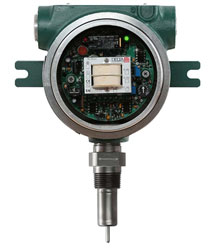
 The microtuf? MODEL LS32CS Basic Point-Level Switch from Delta M provides precise, repeatable liquid level detection in even the most demanding industrial environments. Using advanced thermal differential sensing technology, the LS32CS detects level changes as small as 0.03 inches without being affected by variations in temperature, density, or chemical composition. With a rugged 316L stainless steel construction, no moving parts, and an operating temperature range up to +850°F (+458°C), this reliable point-level switch is ideal for applications such as tank leak detection, reactor charging, and immersion heater protection.
Features
microtuf? MODEL LS32CS Basic Point-Level Switch Features
- Thermal differential point level switch for the detection of liquid level in all vessels.
- Wide operating temperature range -100°F to +850°F (-70°C to +458°C).
- Switch on level change of .03 inch without concern for changing temperature, density, dielectric constant or chemical composition.
- Removable Plug-in electronics
- Two year workmanship warranty.
- Free of all moving parts that can stick, coat or fail.
- Fast response time of .1 to 1 second on wetting, media dependent.
- Self heating sensor design improves repeatability. No separate heater to fail or slow response time.
- Optional Glass window (XW)
Specifications
microtuf? MODEL LS32CS Basic Point-Level Switch Specifications
SENSORS
Type:
Thermal Differential, Dual RTD Sensors
Process Connection:
Standard 0.75 inch MNPT
Optionally 0.5 inch and larger MNPT and various other process connections such as sanitary and flanges
Insertion Length:
Standard 2.0 inch
Optionally 0.5 inch or greater
Operating Temperature Range:
Standard -100°F to 390°F (-70°C to +200°C)
Medium Temperature to +572°F (+300°C)
High Temperature to +850°F (+458°C)
Materials of Construction:
Standard 316L Series Stainless Steel
Optionally Hastelloy, Monel, Inconel and other exotic materials
Operating Pressure Range:
Standard to 3000 psia (207 bar)
ELECTRONICS
Power:
Standard 110VAC Optionally 220VAC, or 24VDC at 3 watts (No heater power required)
Operating Temperature Range:
Standard -40°F to +140°F (-40°C to +60°C)
Optionally remote electronics for use in medium and high temperature environments
Outputs:
DPDT Relay contacts rated at 5 amp, 250 VAC with fail safe capability
Self-Test:
Integral and Automatic during power up.
Enclosure:
Explosion proof; NEMA 3, 4X, 7, and 9; CSA, FM, and UL, approved
INSTRUMENT
Operating Range:
Switch on level change of .03 inch. Available with insertion lengths from 0.5 inch to 30 feet.
Response Time:
Sensor response time 0.1 to 1 second media dependent
Available Approvals:
CE, CSA
Class 1 Div. 1 Groups B, C, & D
Applications
microtuf? MODEL LS32CS Basic Point-Level Switch Applications
- Truck and Railcar Loading
- Immersion Heater Protection
- Reactor/Vessel Charging
- Tank Leak Detection
Q & A
microtuf? MODEL LS32CS Basic Point-Level Switch Q & A
- The standard unit supports –100 °F to +390 °F (–70 °C to +200 °C).
- There are “medium temperature” and “high temperature” sensor options available that extend the upper range to +572 °F and +850 °F respectively.
- The standard pressure rating is up to 3000 psia (≈ 207 bar) for the standard construction.
If your application falls outside those ranges (especially on the high side), you’ll want to confirm with the manufacturer whether a custom or upgraded version is required.
- The standard process connection is 0.75" MNPT.
- Other sizes (0.5" and larger, plus flanges, sanitary styles, etc.) are available as options.
- The standard insertion length is 2.0" (i.e. the sensor’s wetted length).
- Custom insertion lengths from 0.5" up to 30 feet are offered.
You’ll need to choose or specify the insertion length that ensures proper probe reach into your vessel or pipe.
- The LS32CS offers DPDT relay contacts, rated at 5 A, 250 VAC.
- It has built-in self-test functionality at startup.
- No external heater power is required (the sensor is self-heating).
- Electronics are typically “l(fā)ocal” (i.e. housed with the sensor), with an ambient range of –40 °F to +140 °F (–40 °C to +60 °C).
- There is a “remote electronics” option for environments where it’s necessary to distance the electronics from extreme ambient temperature zones.
- Optional built-in RTD or thermocouple outputs (for continuous temperature monitoring) are available.
When specifying, you’ll want to confirm that the output/client interface (relay, RTD, etc.) matches your control system or PLC input requirements.
- The device can detect a level change as small as 0.03 inch (~0.76 mm).
- Its response time (wetting) is in the range of 0.1 to 1 second, depending on the fluid/media.
- Because there are no moving parts (it is thermal differential point sensing), it is less likely to stick, coat, or fail mechanically.
- The self-heating design helps improve repeatability.
In practice, media properties (viscosity, thermal conductivity, fouling tendencies) and installation (probe orientation, flow, turbulence) can affect sensitivity and reliability. It’s good to test in-situ or get performance assurance.
- The standard wetted-material is 316L stainless steel.
- Optional exotic alloys (Hastelloy, Monel, Inconel, etc.) are available for aggressive environments.
- The enclosure is explosion-proof, conforming to NEMA 3, 4X, 7, and 9, and is CSA, FM, and UL approved.
- There is an optional explosion-proof window (XW) for indicator viewing.
- The device carries a two-year workmanship warranty.
If your application is in a hazardous (explosive) environment or involves aggressive chemicals, make sure to confirm the exact certification classes and alloy compatibility.
Downloads
Download Delta M microtuf? MODEL LS32CS Basic Point-Level Switch Datasheet
Contact us at (855) 737-4714 to learn more or fill out our online form.