Q&A Section with Expand/Collapse IconsLift Station With Powered Roller Conveyor Q & A
+ What are the key technical specifications (weight, stroke height, speed, drive) of the Lift Station?
The Robotunits R5L Lift Station supports conveying on two levels with a standard stroke height of up to approximately 5 meters (16.4 feet). It is designed to handle conveyed goods weighing up to 50 kilograms (about 110 pounds) when using dimensionally stable totes. The lift drive uses a three-phase 400 V geared motor capable of speeds up to roughly 1 meter per second with acceleration up to 0.7 m/s2. The integrated powered roller conveyor features a 24 V DC brushless motor that runs at speeds between 10 and 28 meters per minute (0.16-0.47 m/s), depending on the configuration. The unit operates within a temperature range of 2 °C to 40 °C (36 °F to 104 °F) and includes a durable aluminum frame with optional polycarbonate enclosure panels for safety.
+ Can the Lift Station integrate with my existing conveyor system, and how flexible is the configuration?
Yes. The Lift Station is engineered for full compatibility with the Robotunits modular conveyor system and can also be integrated with existing third-party conveyor lines. It supports zero-pressure accumulation (ZPA) control logic, which ensures smooth transitions between zones without product collisions or back-pressure. Because the system is modular and plug-and-play, it can be configured with different roller widths, side guides, lift heights, or even optional turntables and 90-degree transfer units. For North American applications, the lift motor operates at three-phase 400 V, so confirming the appropriate power supply and integration requirements with your plant’s control system is recommended.
+ What product sizes, load carriers, and capacities are supported (and what limitations should I be aware of)?
The Lift Station accommodates typical load carrier dimensions such as 400 × 300 mm, 300 × 400 mm, and 600 × 400 mm, with frame widths commonly ranging from 390 mm to 690 mm, depending on the model. Roller spacing (pitch) varies between approximately 80 mm and 160 mm based on the configuration. It supports loads up to about 50 kilograms (110 pounds) for stable totes or boxes. To achieve optimal performance, it’s important that the load carriers remain dimensionally stable and rigid during lifting and conveying. Users handling larger, heavier, or irregularly shaped items should contact Robotunits for a customized configuration. When installing in the United States, it’s advisable to verify voltage compatibility and safety requirements before integration.
+ What are the lead time, service/support, and maintenance expectations for this system?
Robotunits emphasizes short delivery times for modular conveyor components, and most standard Lift Station modules are available within approximately four weeks. Maintenance requirements are minimal because the Lift Station utilizes modular construction, brushless DC roller motors, and pre-wired control units designed for industrial environments. Robotunits provides comprehensive documentation, including catalogs, operating instructions, and assembly guides, to assist with setup and operation. U.S. customers should confirm local service coverage, parts availability, and field support options before purchase. Integration into existing production lines will also require planning for commissioning, safety checks, and employee training to ensure smooth operation.
+ How safe is the Lift Station, and what safety/guarding features are included (especially for North American industrial compliance)?
The Lift Station features a robust aluminum frame with optional polycarbonate panels that can serve as a safety tunnel or enclosure around the vertical lift section. The powered roller conveyor incorporates patented finger-guard technology to help protect operators during operation. Zero Pressure Accumulation (ZPA) control reduces the risk of product collisions or jamming, further enhancing system safety. For U.S. installations, it’s essential to confirm compliance with OSHA and relevant ANSI/PMMI machine guarding standards, as well as local electrical codes. Safety interlocks, emergency stop buttons, and proper guarding around the lift motion should be included in the installation to ensure operator safety and regulatory compliance.
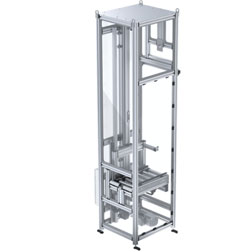 The variable Robotunits lift station enables energy-efficient transport of conveyed goods on two levels. With a speed of up to 1m/s and an acceleration of up to 3m/s2, goods are conveyed to the right place in dimensionally stable containers. The standard conveying height is up to 5 meters. The highlight: The complete conveyor technology from the Robotunits Modular Automation System can be integrated. For Powered Roller Conveyor systems, the lift station is available as a plug-and-play solution. This way, conveying on two levels becomes child’s play.